Key Takeaways
- Boat lighting should support safety, visibility, comfort, and dependable electrical performance.
- Navigation lights must suit the vessel, operating conditions, and applicable navigation rules.
- LED fixtures can reduce power demand, but brightness alone does not prove that a light is suitable.
- Water resistance, corrosion protection, wiring quality, and heat control all matter in marine environments.
- Routine inspections help identify dim output, loose connections, damaged lenses, and water intrusion early.
Why Boat Lighting Deserves Careful Planning
Boat lighting has a larger role than making a vessel look finished after dark. It affects nighttime visibility, safe movement on deck, docking, anchoring, fishing, cabin comfort, and emergency readiness. A thoughtful setup helps crew members find steps, rails, switches, safety gear, and working areas without creating distracting glare at the helm.
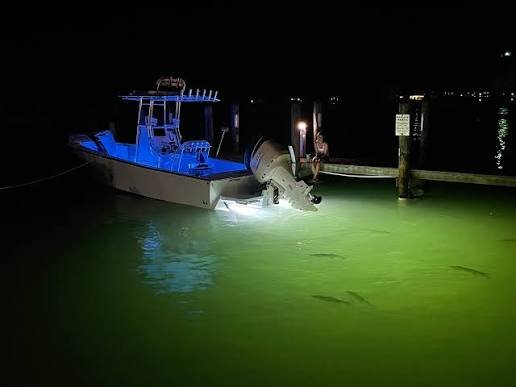
Lighting upgrades often overlap with other maintenance projects, including access panels, pumps, hoses, and marine plumbing parts and supplies. Planning jobs together reduces repeated drilling, simplifies wire routing, and eases inspection in cramped service spaces. Marine conditions damage fixtures through salt spray, humidity, vibration, sun, temperature changes, and impacts, shortening their lifespan. The brightest fixture isn’t always the safest; powerful floodlights can hinder night vision, and poorly placed decorative lights may confuse other boaters. For instance, a boat might have bright blue cockpit strips and underwater lights but still have weak or wrongly mounted navigation lights, making it visible at dock but hard to interpret safely on water.
Navigation Lights And General-Purpose Lights
Navigation lights are safety equipment, not decorations, used to show a vessel’s position, direction, and status to other boaters. General-purpose lights serve work, comfort, or appearance needs but should not interfere with navigation signals. The U.S. Coast Guard warns that unapproved or decorative replacement lights might not meet safety standards or rules. When replacing navigation lights, check their purpose, markings, visibility, and mounting, not just bulb style or lumens.
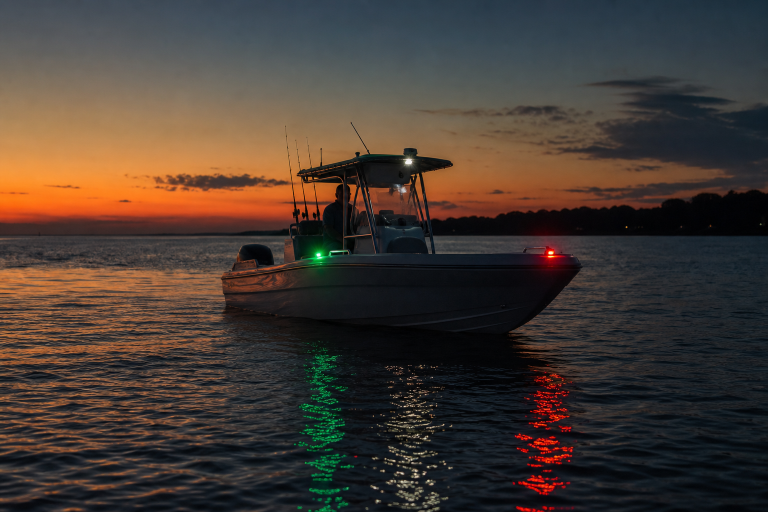
- Navigation lights: Red, green, white, and all-around lights are used to indicate a vessel’s status.
- Deck and spreader lights: Useful for docking, line handling, fishing, and work areas.
- Cockpit and courtesy lights: Low-level illumination for safe movement and passenger comfort.
- Engine-room and service lights: Bright, protected fixtures for inspections and repairs.
- Cabin and reading lights: Focused or dimmable lighting for living spaces.
- Emergency and handheld lights: Independent backup lighting for outages or urgent tasks.
How To Match Lighting To A Boat’s Use
A small day boat used near sunset has different needs from a cruising sailboat, offshore fishing vessel, or liveaboard yacht. Start with the boat’s normal schedule, layout, electrical capacity, and the tasks people perform after dark.
- List every area that needs useful light, including the helm, cockpit, boarding area, cabin, engine room, and storage lockers.
- Identify the lights required for legal navigation before selecting optional fixtures.
- Measure available mounting locations and check for obstructions such as canvas, antennas, rails, and open hatches.
- Confirm whether the boat uses a 12-volt, 24-volt, or another electrical system.
- Choose focused beams for tasks and wide beams for broader work areas.
- Plan access for lens cleaning, fuse replacement, wiring inspection, and future fixture replacement.
Key Features To Check Before Installation
- Voltage range: The fixture should operate properly within the vessel’s real charging and battery voltage range.
- Water resistance: A cabin light needs less protection than a fixture mounted on an exposed bow or near the waterline.
- Corrosion resistance: Check housings, fasteners, lenses, wire leads, and mounting hardware.
- Beam pattern: A narrow spot beam and a broad flood beam solve different problems.
- Color temperature: Warm light can make cabins more comfortable, while neutral light often works well for service areas.
- Brightness control: Dimming can preserve night vision and lower unnecessary power use.
- Heat management: Heat trapped behind a fixture can reduce LED driver and diode life.
- Serviceability: Favor fixtures that can be cleaned, inspected, and replaced without dismantling major components.
LED Lighting: Benefits And Limits
LED lighting is popular because it uses less power, lasts longer, runs cooler at the lens, fits in compact spaces, and offers flexible color options. Those benefits are especially useful on boats that rely on batteries, solar charging, or generator time. Still, not every LED product is suitable for every marine application.
Keep exploringComplete Guide to Scooter Rentals in Bangalore and Bike Hire in Udaipur for Easy Travel
Some LED fixtures emit electrical noise that interferes with radios and other electronics. Poor heat dissipation can shorten service life, weak seals can allow moisture ingress, and thin wiring may fail under vibration. Most importantly, an LED bulb that fits an older navigation-light socket may not reproduce the required color, beam shape, or certified optical performance.
Marine Wiring And Installation Basics
Reliable lighting depends on proper wiring beyond the fixture. Use correctly sized conductors, protect circuits with fuses or breakers, and secure wiring to prevent chafing. Marine-grade terminals and heat-shrink protect against corrosion. Keep connections dry, seal deck penetrations, and label switches and circuits for troubleshooting. Navigation lights need extra care to prevent safety issues. For new circuits, voltage diagnostics, or compliance concerns, hire a qualified marine electrician.
Common Boat Lighting Mistakes
- Choosing fixtures based only on appearance or a high lumen rating.
- Mounting lights where they shine into the operator’s eyes or reflect off bright surfaces.
- Using household connectors or wiring products in damp marine spaces.
- Leaving unused wire ends exposed to moisture and corrosion.
- Mixing incompatible LED fixtures, dimmers, and drivers.
- Installing lights where lenses and wiring cannot be inspected.
- Replacing a navigation light without confirming its approved application and orientation.
A Simple Inspection And Maintenance Plan
Check lighting at the start of each boating season, after severe weather, and before every nighttime trip. U.S. Coast Guard boating guidance explains that navigation lights are displayed from sunset to sunrise and during periods of restricted visibility, making a pre-departure check especially important.
- Turn on every light from its normal switch.
- Watch for flickering, delayed startup, or uneven brightness.
- Inspect lenses for cracking, clouding, salt buildup, and trapped moisture.
- Look for green corrosion around terminals, connectors, and fuse holders.
- Check brackets, screws, cable supports, and mounting surfaces.
- Confirm that navigation lights show the correct color and direction.
- Clean lenses gently with a soft cloth and a suitable cleaner.
- Record repairs and replacement dates for easier maintenance tracking.
Frequently Asked Questions
Are Brighter Boat Lights Always Better?
No. Effective lighting depends on beam control, placement, color, and the task. Excessive brightness can reduce night vision and make it harder to see beyond the illuminated area.
Can Any LED Bulb Replace An Older Marine Bulb?
Not necessarily. The socket may fit while the electrical behavior, heat characteristics, beam pattern, color, or certification requirements do not. Verify compatibility before changing a navigation light.
How Often Should Boat Lights Be Checked?
Inspect them before nighttime outings, after heavy weather, and during seasonal maintenance. A quick functional test takes little time and can reveal issues before departure.
Conclusion
Good boat lighting balances safety, compliance, energy use, comfort, and serviceability. Choose fixtures based on the vessel’s actual needs, protect the wiring, avoid glare, and inspect every light regularly. A carefully planned system makes nighttime boating more comfortable while helping essential lights perform when they matter most.
