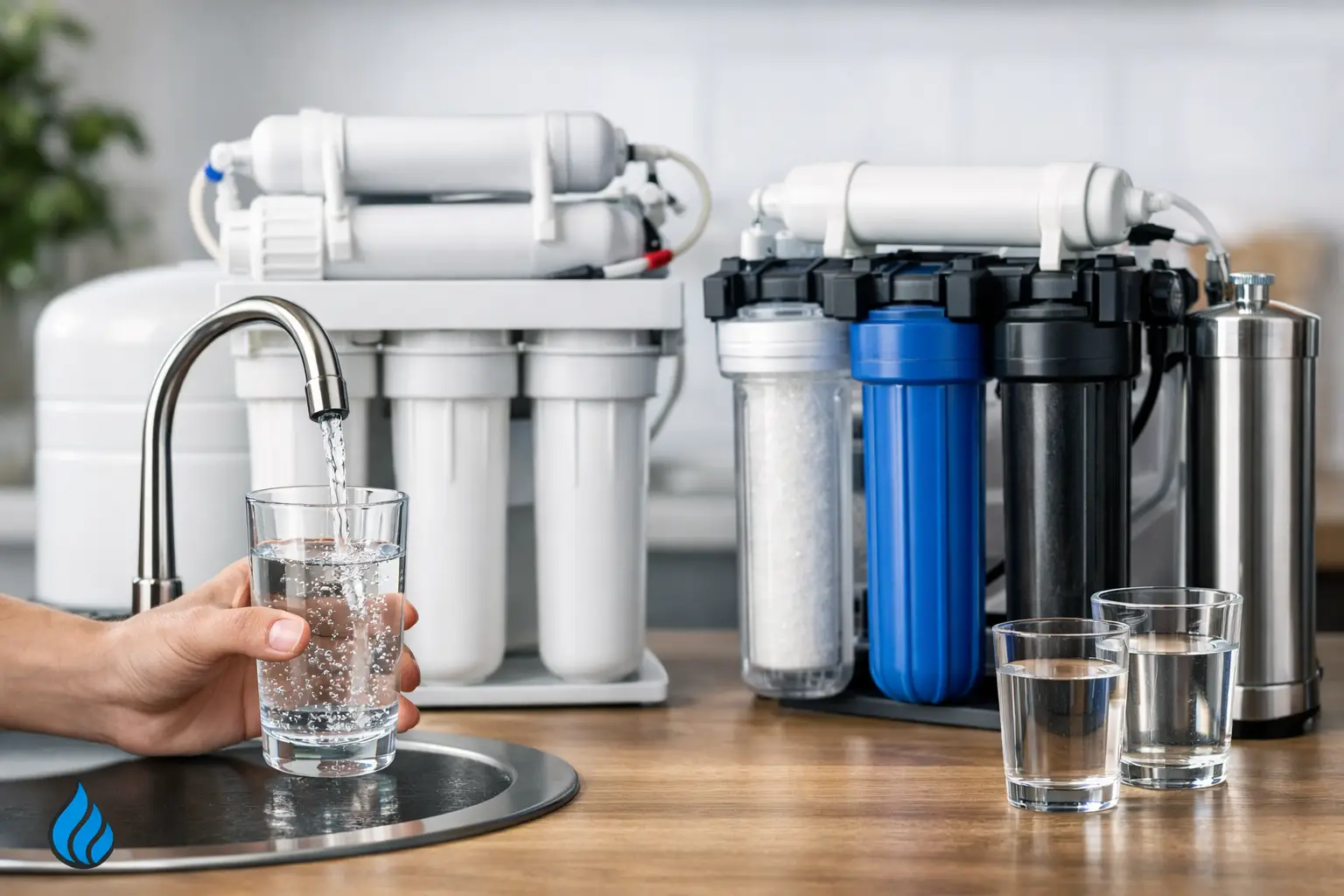
Water has a funny way of becoming invisible in our daily lives. We turn on the tap, fill the kettle, wash our hands, and move on. Then something changes. Maybe there’s an orange ring around the sink. Perhaps the laundry develops rusty-looking marks, or the water has a faint metallic taste.
That’s usually when homeowners start searching for answers.
The trouble is, water problems aren’t always as simple as they look. A stain may suggest iron, but other water-quality conditions can contribute to similar issues. Hardness, sediment, pH, sulfur, and other factors can also affect how water looks, smells, and behaves.
So before buying a treatment system, it pays to slow down and figure out what’s actually happening.
Keep exploringWhat Your Tap Water Is Telling You: A Simple Guide to Better Water Quality
The First Step Is Understanding Your Water
Every home has a slightly different water story.
Municipal water goes through treatment before reaching your property, while private well water can vary considerably based on local geology and groundwater conditions. Even homes in the same neighborhood may experience different water characteristics.
A basic water analysis can look at hardness, pH, iron, manganese, chlorine, sediment, and other factors. Additional testing may be appropriate depending on the water source and local concerns.
Keep exploringBetter Water Starts With Better Treatment: Understanding Chlorine, Chloramines and Corrosive Water
This is important because treatment equipment isn’t interchangeable. A filter designed to capture sediment isn’t automatically designed to remove dissolved iron. A softener can address hardness, but it isn’t a universal contaminant-removal system.
Knowing the problem first makes choosing the solution much easier.
When Iron Becomes the Culprit
Iron is one of the more common reasons homeowners start looking into water treatment.
It can leave reddish-orange marks around sinks, toilets, tubs, and shower fixtures. Laundry can pick up stubborn discoloration, and water may develop a metallic taste.
Keep exploringChoosing the Right Water System for a More Comfortable Home
In some cases, dissolved iron is invisible when water first comes out of the faucet. Once it encounters oxygen, however, it can oxidize and form visible particles.
The form and concentration of iron matter. That’s why iron filter/problem water filter systems aren’t one-size-fits-all solutions.
Some systems use specialized media to capture iron, while others first oxidize dissolved iron and then filter it. The right approach depends on water chemistry, flow rate, iron concentration, pH, and other conditions.
A system that works beautifully for one household may perform poorly in another if those factors are different.
Keep exploringWhen a Water Softener Needs Attention: Installation, Repairs, and Maintenance
Why a Comprehensive Water Analysis Helps
It’s tempting to focus on the most obvious symptom. If you see orange stains, you assume iron is the only problem.
Sometimes it is. Sometimes it isn’t.
A comprehensive in-home water analysis can provide a broader view of what’s happening. Depending on the provider and testing method, it may examine several characteristics of the water and help identify potential treatment needs.
This wider perspective matters because water-quality problems can overlap.
For example, a home may have iron along with hardness. Another may have sediment and an unpleasant sulfur odor. A third might have perfectly acceptable hardness but need drinking-water filtration for a specific concern.
Treating one issue while ignoring another can leave you wondering why the new system isn’t performing as expected.
Keep exploringHow Better Water Filtration Can Keep Commercial Businesses Running Smoothly
The Value of a Simple Water Test
If you’ve never had your water tested, starting with a free water test may be a practical way to learn more before making a major purchase.
Depending on the service, testing may provide information about hardness, iron, pH, chlorine, and other water characteristics. If a provider offers an in-home evaluation, use the opportunity to ask questions rather than simply listening to a sales presentation.
What exactly was found?
What does the recommended equipment remove?
What won’t it remove?
How often does the system need maintenance?
What will replacement filters or media cost?
Those questions are more useful than simply asking which system is “best.”
Whole-House Treatment Can Solve More Than One Headache
If water-quality problems affect multiple parts of the house, whole-home treatment may make more sense than a small point-of-use filter.
Think about how much water your household actually uses. Showers, washing machines, dishwashers, toilets, faucets, and water heaters all rely on the same supply.
If iron is causing staining throughout the home, treating only drinking water won’t solve the orange marks in the bathroom.
Likewise, if hard water is creating scale around fixtures and inside appliances, a drinking-water filter isn’t designed to address that problem throughout the property.
Treatment should happen where the problem occurs.
Don’t Ignore Water Chemistry
Water treatment is a little like cooking. You can have excellent ingredients, but the result depends on how they interact.
pH, hardness, iron, manganese, sediment, and other characteristics can influence how treatment equipment performs.
For example, some iron-removal technologies work better within certain pH ranges. High sediment levels may require prefiltration. Hardness can also affect equipment and may need to be addressed separately.
This is why proper testing and system sizing are so important.
If a provider recommends equipment without explaining how your water chemistry influenced the recommendation, it’s reasonable to ask for more detail.
Maintenance Keeps Treatment Working
Installing a system is not the finish line.
Filters need to be replaced. Media may need cleaning or eventual replacement. Backwashing systems require appropriate settings and water flow. Components can wear out.
Neglected maintenance can cause a system to lose effectiveness long before its expected service life.
Keep a simple record of filter changes and servicing. If the water suddenly develops the same taste, odor, or staining you were trying to eliminate, don’t automatically assume you need a completely new system.
Sometimes the answer is much simpler: a filter is overdue, a setting has changed, or a component needs attention.
Think About Long-Term Costs
When comparing treatment systems, look beyond the initial price.
Ask about installation, replacement media, filter cartridges, salt if applicable, electricity, maintenance, and warranty coverage.
A system that costs less upfront isn’t necessarily cheaper over five or ten years. Likewise, a premium system isn’t automatically better for every household.
The best choice is usually a balance between performance, capacity, maintenance, and long-term affordability.
And don’t be afraid to get another opinion. Water treatment is a significant household purchase, and you should feel comfortable with the reasoning behind it.
The Right Solution Starts With the Right Question
When water seems strange, the natural instinct is to fix the visible problem as quickly as possible. But the better question is: Why is this happening?
Once you understand what’s actually in your water, treatment becomes much less mysterious.
Test first. Look at the complete water picture. Choose equipment designed for the specific conditions. Keep it maintained. And don’t pay for technology you don’t need.
Whether the issue is iron, hardness, sediment, taste, odor, or something less obvious, the goal remains the same: water that works better for your home and creates fewer headaches along the way.
Good water treatment doesn’t need to be complicated. It just needs to be thoughtful, properly matched, and maintained over time. Sometimes the simplest improvements are the ones you appreciate most every day.